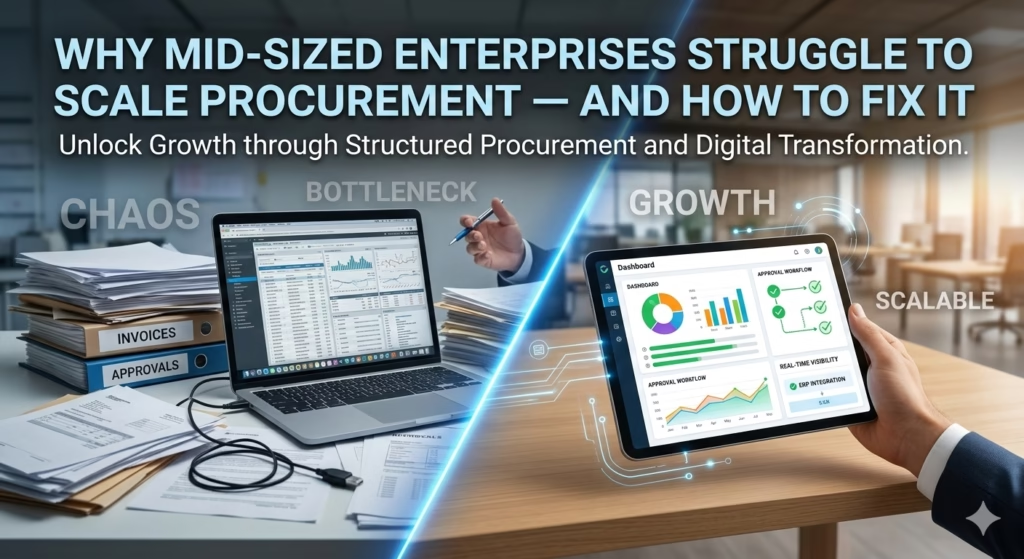
Mid-sized enterprises are built for growth. New locations are added, vendor networks expand, transaction volumes increase, and leadership begins demanding tighter financial control.
But procurement often grows in a very different way.
What starts as a flexible, fast moving process gradually becomes a bottleneck. Approvals take longer. Spend visibility becomes unclear. Vendor coordination consumes more time than expected. Finance teams struggle to track commitments accurately.
The challenge is not procurement itself — it is that the process that worked at a smaller scale was never designed for growth.
The Scaling Gap Most Enterprises Don’t See Coming
In early stages, procurement is informal but manageable. A few people coordinate with vendors, approvals happen through email, and finance reconciles transactions at the end of the cycle.
As the organization expands, this same model is stretched across multiple departments, higher purchase volumes, and larger contract values.
The result is a scaling gap.
Procurement is expected to support a larger, faster-moving business — without the structure, visibility, or system alignment required to do so.
This is when delays begin to affect operations, not just purchasing.
When Flexibility Turns Into Operational Friction
The very flexibility that once helped the organization move quickly starts creating friction.
Different departments follow different purchasing practices.
Vendor data exists in multiple formats.
Approval paths become unclear as reporting structures grow.
Procurement teams spend more time following up than analyzing.
At this stage, the issue is no longer efficiency. It becomes governance.
Leadership needs reliable data for planning. Finance needs real-time committed spend.
Compliance requires traceable decisions.
Without a structured environment, procurement cannot meet these expectations consistently.
The Financial Impact of an Unscalable Procurement Model
For mid-sized enterprises, the cost of an unstructured procurement process is rarely visible as a single line item.
Instead, it appears as:
Delayed projects due to slow approvals
Inaccurate cash flow planning
Missed cost-saving opportunities
Increased audit preparation effort
Limited control over decentralized purchasing
Individually, these may seem manageable. Together, they restrict the organization’s ability to scale confidently.
Why Hiring More People Doesn’t Solve the Problem
A common response to procurement delays is to add more resources.
But scaling a manual or semi-structured process only multiplies coordination effort. More people means more follow-ups, more data duplication, and more dependency on individual knowledge.
The real solution is not additional manpower — it is a system that creates consistency.
What Scalable Procurement Actually Looks Like
A scalable procurement environment is not defined by speed alone. It is defined by predictability and visibility.
Approvals follow predefined workflows, regardless of department.
Vendor information is centralized and compliance-ready.
Procurement transactions align in real time with financial systems.
Leadership can see committed spend without waiting for manual reports.
When these elements are in place, procurement stops being a bottleneck and starts supporting growth.
Fixing the Foundation for Growth
For mid-sized enterprises, the shift toward scalable procurement begins with digitizing and connecting the process.
Platforms like Procure Smart enable this transition by replacing email-driven coordination with workflow-based approvals, centralizing vendor management, and aligning procurement data with ERP environments.
The impact is immediate and measurable.
Procurement cycles become faster because decisions follow a defined path.
Finance gains accurate, real-time visibility.
Audit readiness improves because every transaction is traceable.
Leadership gets the clarity required for expansion.
Growth no longer creates procurement friction — it becomes supported by it.
The Strategic Advantage
Enterprises that fix procurement at the right stage scale differently.
They expand into new locations without losing control.
They onboard new vendors without increasing risk.
They plan investments with accurate financial commitments.
Most importantly, procurement shifts from being an operational necessity to a function that actively supports business strategy.
Ready to Make Procurement Scalable?
If your procurement process still depends on follow-ups, manual tracking, and disconnected systems, growth will continue to increase complexity.
The right time to fix procurement is not after it slows the business down — it is when the organization is preparing to scale.
See how Procure Smart helps mid-sized enterprises build a procurement function that grows with them.
Request a walkthrough and explore what scalable procurement looks like in practice.