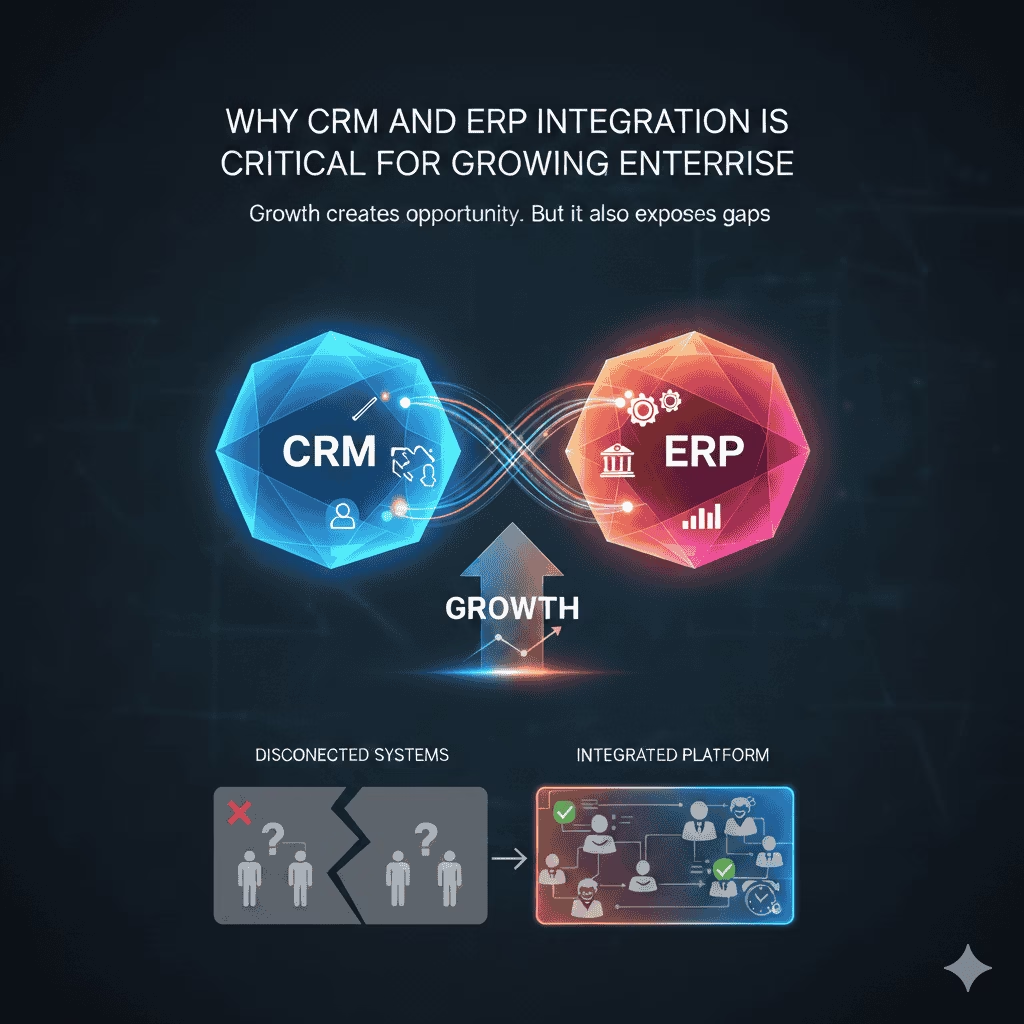
Growth creates opportunity. But it also exposes gaps.
As enterprises scale, sales volumes increase, customer interactions multiply, vendor networks expand, and financial oversight becomes stricter. What once worked in disconnected systems begins to create friction.
Many growing companies invest in CRM to manage customers and ERP to manage operations. But when these systems operate separately, the result is inefficiency, misalignment, and missed visibility.
CRM and ERP integration is no longer optional for growing enterprises — it is foundational.
The Hidden Cost of Disconnected Systems
When CRM and ERP are not integrated, teams work with incomplete information.
Sales may close deals without knowing inventory constraints.
Finance may process invoices without understanding customer commitments.
Operations may struggle to align supply with real-time demand signals.
This creates:
Delayed order fulfillment
Revenue leakage from mismatched pricing
Manual reconciliation between departments
Reduced forecasting accuracy
- Frustration across teams
Growth magnifies these issues. What was manageable at a smaller scale becomes disruptive at enterprise level.
What Changes When CRM and ERP Work Together
Integration transforms how departments collaborate.
When CRM and ERP systems are connected:
Sales teams see order status, credit limits, and payment history in real time.
Finance teams gain visibility into customer engagement context.
Leadership sees committed revenue aligned with operational capacity.
Procurement and inventory align directly with demand trends.
Data flows automatically. Decisions are based on unified information. Manual coordination reduces.
Instead of asking, “Which system has the correct data?”
Teams ask, “How do we act on this data?”
Why Growing Enterprises Cannot Delay Integration
At early stages, disconnected systems may seem manageable. But as enterprises grow:
Transaction volumes increase
Compliance requirements tighten
Stakeholders demand real-time insights
Decision cycles shorten
Without CRM and ERP integration, organizations struggle to maintain accuracy and control.
Integration is not about adding complexity. It is about reducing operational friction while improving visibility and accountability.
The Strategic Advantage of Unified Customer and Operational Data
Growing enterprises that integrate CRM and ERP gain more than efficiency. They gain strategic clarity.
They can:
Forecast revenue with greater accuracy
Monitor committed vs actual performance
Identify customer profitability trends
Align procurement and operations with demand
- Reduce internal disputes caused by data inconsistencies
This unified approach strengthens both customer experience and internal governance.
Where SMACON Fits In
SMACON’s Customer Management Solution is designed with integration in mind. It does not operate in isolation. It connects customer data with enterprise systems, helping organizations eliminate silos and build structured workflows.
For enterprises already investing in ERP systems, integration ensures customer engagement aligns with operational and financial execution.
Growth should increase efficiency — not create complexity.
Ready to Align Your Systems for Scalable Growth?
If your CRM and ERP systems are operating separately, your teams are likely compensating manually.
Now is the time to eliminate that friction.
Explore how SMACON’s Customer Management Solution integrates with enterprise systems to support scalable growth.
Request a demo to see how unified CRM and ERP visibility transforms decision-making.
Because growing enterprises don’t just need more software.
They need connected systems.