Controlled Procurement: The Stage Where Growing Enterprises Regain Visibility
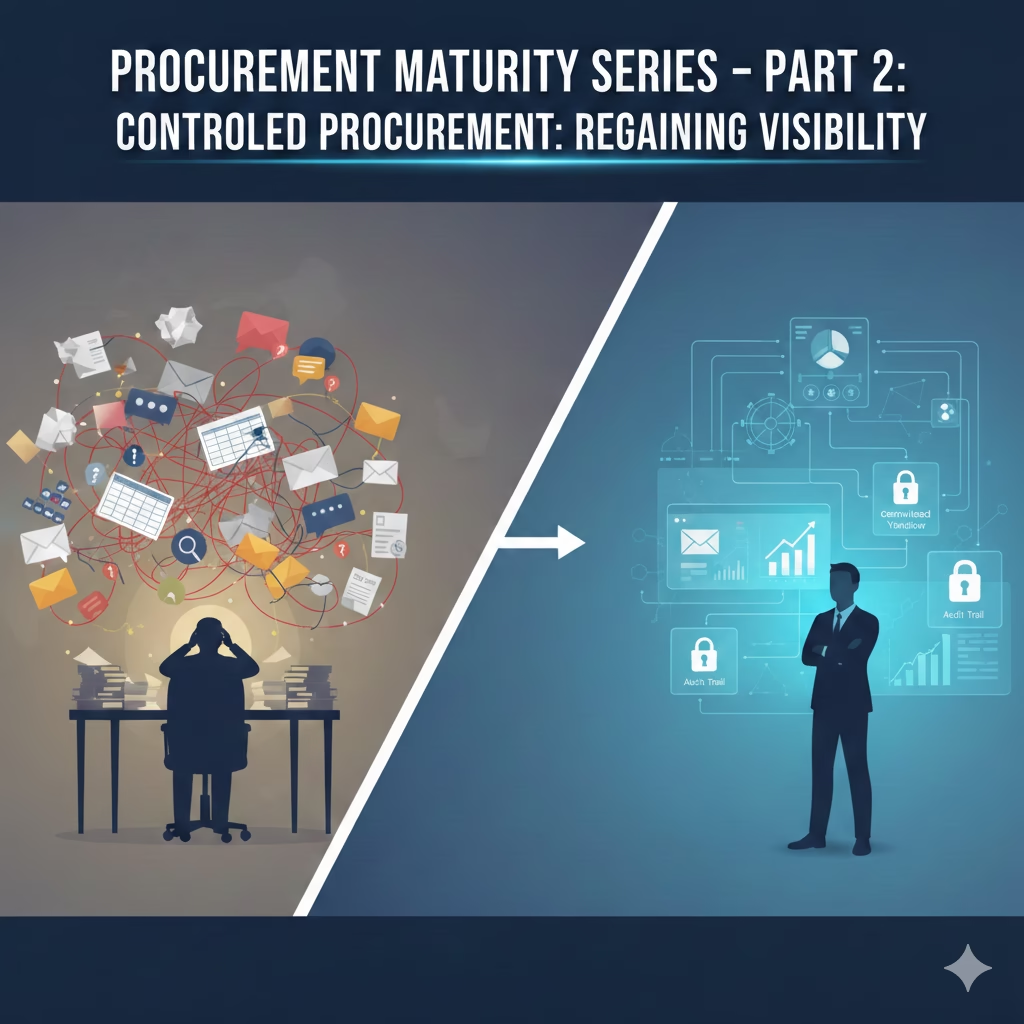
As organizations grow, procurement can no longer depend on follow-ups, individual ownership, and informal coordination. What once worked through emails and spreadsheets starts creating delays, inconsistent vendor communication, and limited financial visibility.
This is the stage where many mid-sized and large enterprises introduce structure into procurement — not as a process improvement, but as a governance requirement.
Controlled procurement is the point where purchasing activity becomes traceable, approvals become policy-driven, and leadership begins to trust the data coming from procurement.
From Coordination to Control
In reactive environments, procurement moves forward through constant communication — someone sends an email, someone follows up, someone checks a file. The process exists, but it lives in people’s inboxes and memory.
In a controlled environment, the process lives inside the system.
Approval hierarchies are defined. Vendor records are centralized. Every transaction leaves a clear audit trail. Instead of asking “Who approved this?”, teams can instantly see the entire history.
This shift does not slow procurement down. It removes uncertainty.
And for growing enterprises, removing uncertainty is the first step toward scalability.
Why This Stage Matters for Mid to Large Enterprises
At a certain size, procurement is no longer just about buying — it becomes closely tied to finance, compliance, and risk management.
Finance teams need to understand committed spend before payments happen.
Compliance teams need documentation that is already structured.
Leadership needs visibility that does not depend on manual reports.
Controlled procurement brings this clarity. It creates an environment where transactions are consistent, policies are enforced automatically, and procurement data becomes reliable.
This reliability is what allows enterprises to grow without losing financial control.
The Operational Impact
When procurement becomes controlled, the change is visible across the organization.
Audit preparation becomes faster because the documentation already exists in the right format.
Vendor communication becomes more consistent because information is no longer scattered.
Department teams experience fewer delays because approvals follow predefined paths.
Most importantly, procurement stops being seen as a bottleneck and starts becoming a dependable function.
That shift in perception is critical for enterprises scaling their operations.
Why Many Organizations Plateau Here
Controlled procurement is a major step forward — but it is not the final stage.
In many enterprises, workflows are structured but still disconnected from ERP and finance systems. Vendor data is centralized, but reporting still requires manual effort. Visibility improves, but it is not yet real-time.
At this point, procurement is stable — but not fully aligned with the rest of the business.
And that limits its strategic value.
Enabling Control Without Adding Complexity
For controlled procurement to succeed, structure must not create additional administrative work.
This is where digital procurement platforms such as Procure Smart support growing enterprises. By embedding approval workflows, centralizing vendor management, and providing real-time transaction visibility, control is achieved without increasing coordination effort.
The procurement function becomes predictable, policy-driven, and audit-ready — while remaining fast and scalable.
The Maturity Shift
Reaching the controlled stage means an organization has moved beyond firefighting.
Procurement becomes measurable, traceable, and aligned with governance expectations.
But the real transformation happens in the next stage — when procurement is no longer just controlled, but fully connected with ERP and finance.
In the next part of this series, we will explore:
Integrated Procurement – where procurement, finance, and operations work from the same data in real time.