Growth brings complexity.
As enterprises expand across locations, departments, and business units, purchasing decisions begin to happen everywhere – not just within a single procurement team. What was once a centralized, easy-to-track process becomes distributed across multiple stakeholders, each with their own vendors, approval patterns, and urgency.
Decentralized purchasing is not a flaw. In many cases, it is necessary for operational speed.
The real challenge is maintaining control without slowing the business down.
When Purchasing Happens Everywhere, Visibility Disappears
In a decentralized environment, departments raise their own requests, negotiate with vendors, and follow different approval paths based on urgency and local practices.
Over time, this creates a familiar situation:
Finance sees the financial impact only after purchases are made.
Procurement struggles to enforce standard vendor policies.
Leadership lacks a real-time view of committed spend.
The organization continues to function – but without a single, reliable picture of procurement activity.
This is where risk begins to grow silently.
The Governance Challenge Behind Decentralization
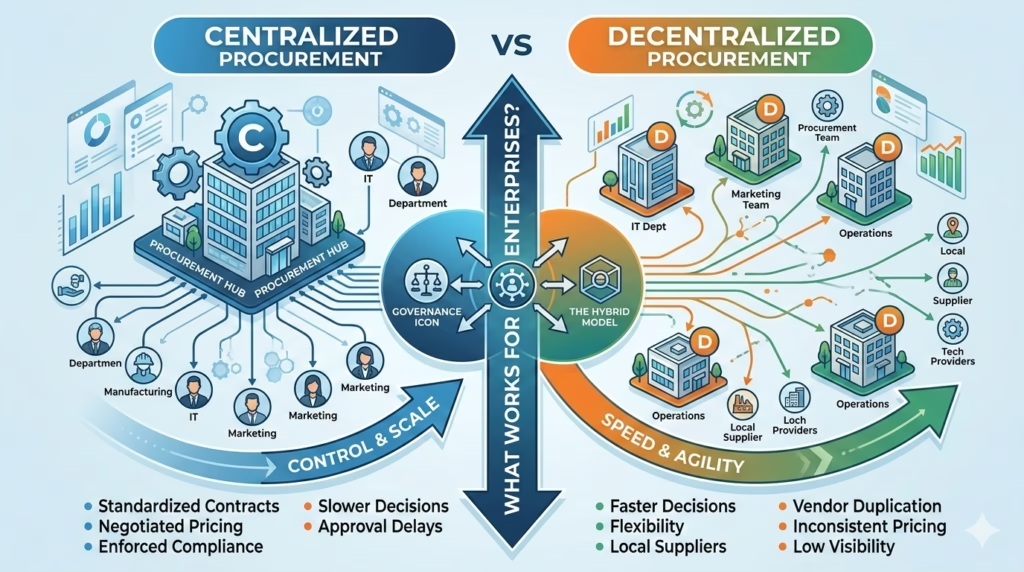
Decentralized purchasing is often introduced to improve speed and autonomy for business units. But without a structured system, it leads to:
Inconsistent vendor selection
Duplicate suppliers across departments
Uncontrolled pricing variations
Policy deviations that are difficult to trace
For growing enterprises, this is not just an operational issue — it becomes a governance concern.
The question is no longer “Who is buying?”
It becomes “Are we buying in a controlled, compliant, and financially aligned way?”
Why Traditional Centralization No Longer Works
The immediate reaction to decentralization is often to pull everything back under a single procurement function.
In modern enterprises, this approach fails.
Business units need the flexibility to move fast. Local teams need the ability to raise and track their own requirements. Operations cannot wait for a single centralized queue.
The goal is not to eliminate decentralization.
The goal is to control it through visibility, policy, and system-driven workflows.
Creating Control Without Slowing Down the Business
Enterprises that successfully manage decentralized purchasing follow a different approach.
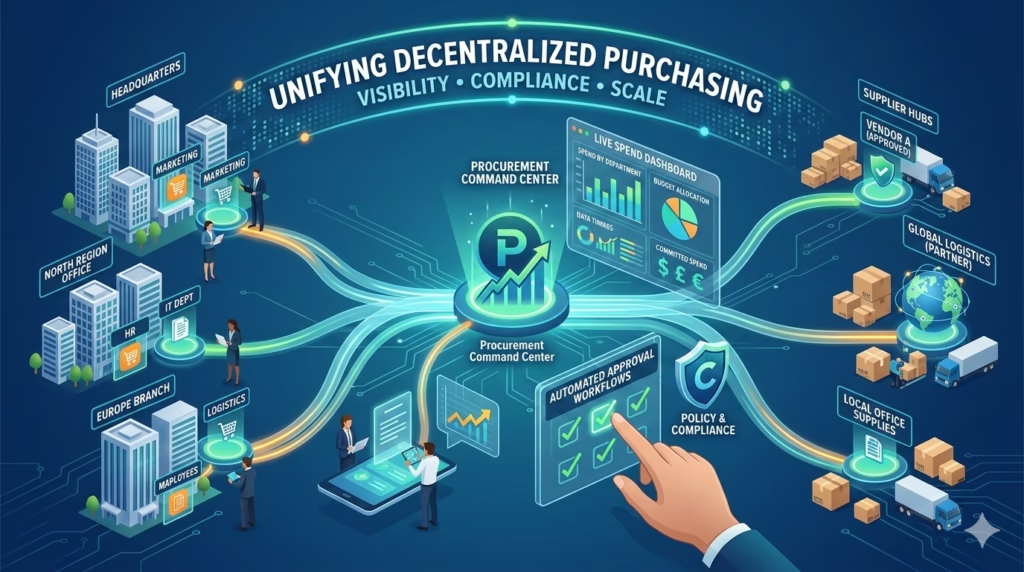
They allow requests to originate from anywhere in the organization — but ensure that every transaction moves through a standardized, traceable process.
This creates an environment where:
All vendors are onboarded through a single compliance-driven framework
Approval hierarchies are enforced automatically based on value and department
Pricing and quotation comparisons follow a uniform method
Leadership can view committed spend across locations in real time
Purchasing remains decentralized in execution — but centralized in control.
That distinction is what enables scale.
The Role of Digital Procurement Platforms
This level of control cannot be achieved through manual coordination.
It requires a system that connects departments, procurement, and finance while allowing each stakeholder to operate within their defined role.
Platforms like Procure Smart are designed for this environment. By providing role-based access, workflow-driven approvals, centralized vendor management, and real-time visibility across business units, enterprises gain control without taking away operational flexibility.
Every purchase follows policy — regardless of where it originates.
The Strategic Impact for Growing Enterprises
When decentralized purchasing becomes structured:
Finance gains accurate, real-time commitment visibility
Procurement enforces vendor and pricing standards consistently
Department teams continue to move fast without compliance risk
Leadership gets a consolidated view across the entire organization
The result is not just efficiency.
It is confidence in decision-making.
Expansion into new locations becomes easier because the procurement framework is already scalable. Vendor negotiations become stronger because the organization operates as a single buying entity. Audit preparation becomes faster because every transaction is traceable.
From Decentralized Activity to Unified Control
Decentralized purchasing is a natural outcome of growth.
But unmanaged decentralization leads to financial leakage, compliance gaps, and limited visibility.
Enterprises that scale successfully do not reverse decentralization — they digitize and structure it.
Explore how Procure Smart helps growing enterprises bring visibility, compliance, and control to decentralized purchasing — without slowing down operations.
Request a walkthrough to see how it works across departments and locations.