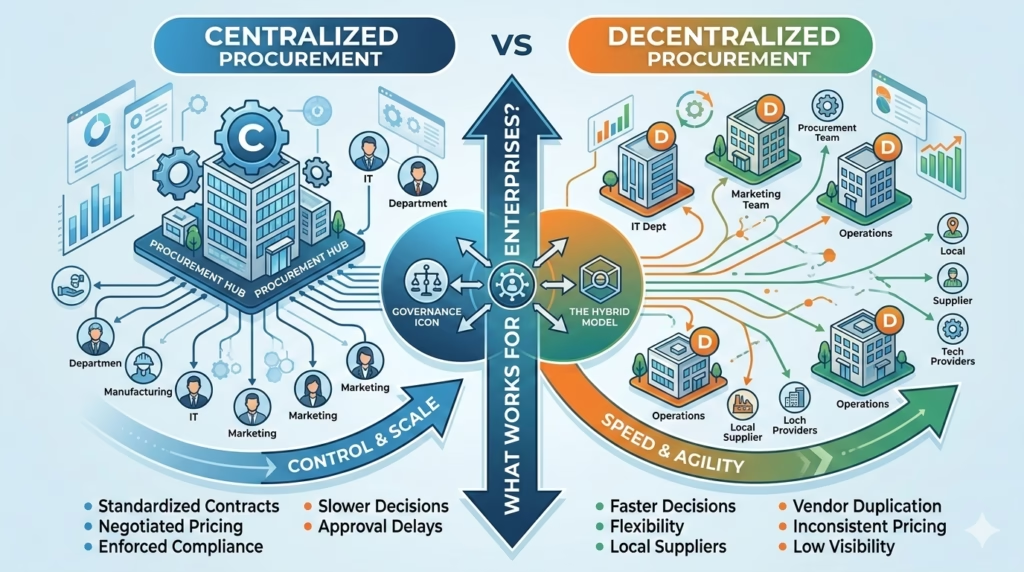
In many organizations, procurement problems don’t start with people — they start with systems that don’t talk to each other. Purchase requests sit in one tool, approvals happen over email, vendor data lives in spreadsheets, and invoices are processed somewhere else entirely. When something goes wrong, no one knows exactly where the breakdown happened.
This is what disconnected systems create: disconnected accountability.
As businesses move closer to 2026, procurement is no longer judged only on cost savings. It is measured on compliance, traceability, audit readiness, and decision clarity. And none of that is possible when procurement data is scattered across multiple platforms.
When Procurement Systems Don’t Connect, Accountability Fails
In a disconnected procurement environment, every stage of the process operates in isolation. A purchase requisition may be raised in one system, approved verbally or through email, executed by another team, and recorded later for accounting purposes.
When discrepancies arise — delayed orders, pricing mismatches, compliance violations, or audit questions — teams are forced to reconstruct events manually.
At that point, accountability becomes unclear:
Who approved the purchase?
Was the vendor compliant at the time?
Were procurement policies followed?
Did the process deviate, and where?
Without a single, connected system, these answers are often based on assumptions rather than facts.
Compliance Risks Multiply in Fragmented Procurement Processes
Compliance is one of the first casualties of disconnected procurement systems. When vendor onboarding, RFQs, approvals, purchase orders, and invoices are handled across different tools, enforcing procurement policies becomes extremely difficult.
Common compliance gaps include:
Purchases made without proper approval
Vendors missing mandatory compliance documents
Inconsistent pricing and untracked negotiations
Missing audit trails for RFQs and vendor selection
Manual overrides with no justification or record
These gaps don’t just create operational risk — they expose businesses to financial penalties, audit failures, and reputational damage.
Why Accountability Needs a Single Source of Truth
Accountability in procurement is not about blame; it’s about clarity.
When every action is captured in one connected platform, responsibility becomes transparent and measurable.
A unified procurement system ensures:
Every approval is logged with user, date, and time
Vendor actions and submissions are traceable
Changes, re-quotes, and negotiations are recorded
Documents are centrally stored and audit-ready
Stakeholders see the same data, in real time
This is where smart procurement platforms like Procure Smart change the equation.
Building Trust Through Process, Not Promises
Procure Smart is built to eliminate system silos by centralizing the entire procurement lifecycle. Instead of scattered workflows, it creates a connected, policy-driven environment where accountability is built into the process.
With Procure Smart:
Purchase requests flow seamlessly from ERP systems
RFQs are issued, tracked, and compared digitally
Vendor compliance is verified and documented
Approvals follow defined workflows, not emails
Audit trails are generated automatically
Every decision leaves a digital footprint. There is no ambiguity about who did what, when, and why.
Final Thoughts
Disconnected systems don’t just slow procurement down — they dilute responsibility. And when accountability breaks down, trust breaks with it.
Smart procurement platforms like Procure Smart bring structure, transparency, and compliance back into procurement operations. They ensure that every process is connected, every decision is traceable, and every stakeholder is accountable.
In a future driven by audits, analytics, and automation, connected procurement is the only sustainable path forward.