Many businesses assume CRM and ERP are interchangeable. After all, both manage data, support business operations, and help improve efficiency. But in reality, CRM (Customer Relationship Management) and ERP (Enterprise Resource Planning) serve very different purposes.
Understanding the difference between CRM and ERP is critical for mid to large enterprises looking to streamline operations and improve visibility across departments.
What Is CRM?
CRM, or customer relationship management software, is designed to manage customer interactions and relationships.
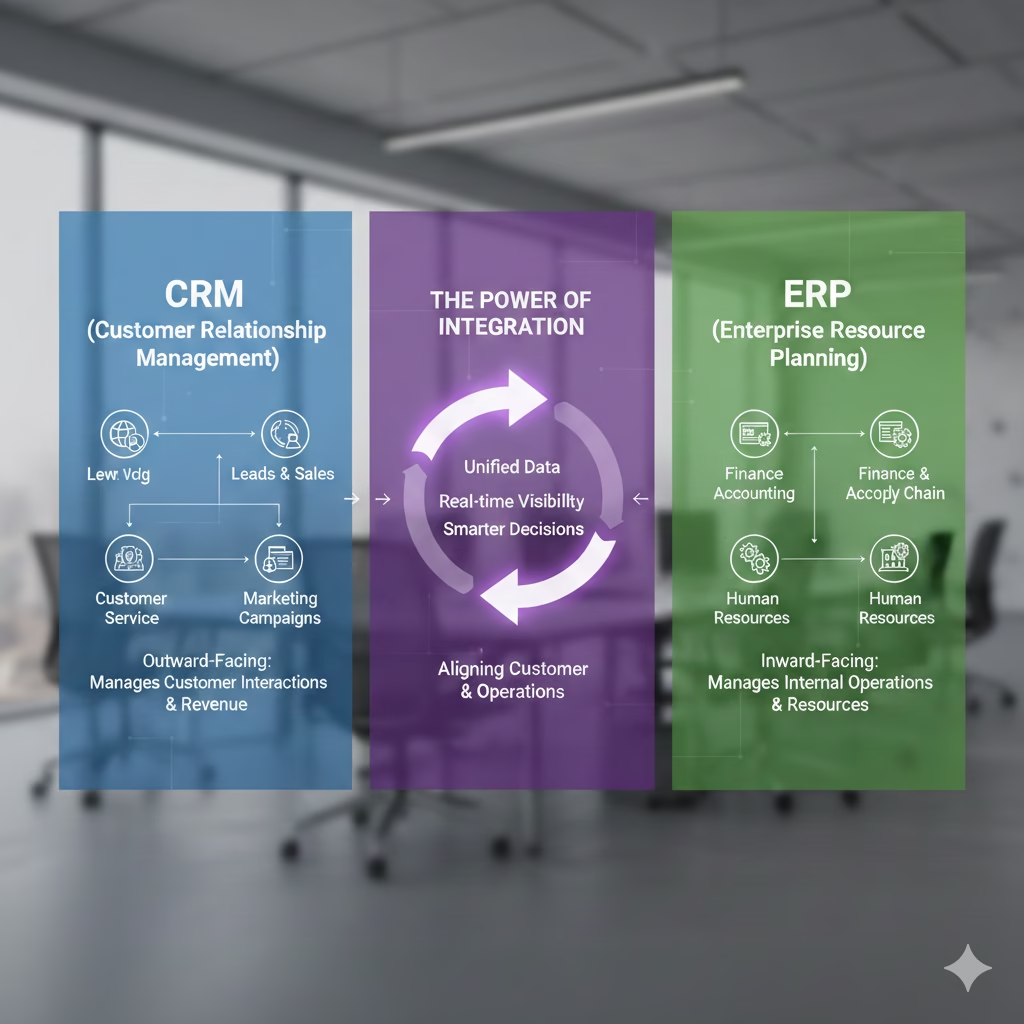
It focuses on front-end activities such as:
-
Managing leads and opportunities
-
Tracking sales pipelines
-
Monitoring customer interactions
-
Supporting marketing campaigns
- Handling customer service and support
The primary goal of a CRM system is to improve customer engagement, increase sales effectiveness, and strengthen customer retention.
A modern CRM platform helps businesses maintain a 360-degree view of customers — including communication history, buying patterns, and service records.
What Is ERP?
ERP, or enterprise resource planning software, focuses on back-end business operations.
It typically manages:
-
Finance and accounting
-
Inventory and supply chain
-
Procurement and purchasing
-
Production planning
- Human resources
ERP systems are built to centralize operational data and ensure different departments work from the same financial and transactional information.
In simple terms:
CRM manages customer-facing processes.
ERP manages internal business operations.
CRM vs ERP: The Core Difference
The difference between CRM and ERP comes down to focus.
CRM is outward-facing. It helps businesses manage relationships and drive revenue.
ERP is inward-facing. It ensures operational efficiency, financial control, and process standardization.
CRM answers:
“How do we manage and grow customer relationships?”
ERP answers:
“How do we manage resources, transactions, and operations efficiently?”
Both are essential — but they solve different problems.
Why Enterprises Need Both
For mid to large enterprises, using only CRM or only ERP creates gaps.
If you have CRM without ERP integration:
-
Sales teams may lack visibility into order status or payment data.
-
Customer commitments may not align with inventory or financial realities.
If you have ERP without CRM:
-
Customer interactions remain disconnected.
-
Sales pipelines lack structured tracking.
- Engagement data becomes scattered.
Modern enterprises increasingly require CRM and ERP systems to work together, creating a unified environment where customer interactions align with operational execution.
The Power of CRM and ERP Integration
When CRM and ERP are integrated:
-
Sales teams see real-time order and payment information.
-
Finance teams understand customer engagement context.
-
Procurement and inventory align with demand signals.
-
Leadership gains full visibility across revenue and operations.
This integration reduces manual coordination, eliminates duplicate data entry, and improves decision-making accuracy.
SMACON’s Customer Management Solution is designed to integrate with enterprise systems, ensuring customer data is not isolated from operational and financial processes.
Which One Does Your Business Need?
If your focus is improving customer engagement, sales tracking, and retention — you need CRM.
If your focus is improving internal operations, financial control, and supply chain management — you need ERP.
But for growing enterprises, the real advantage comes from connecting both.
Final Thought
CRM and ERP are not competitors — they are complementary systems.
Understanding the difference helps businesses design smarter digital ecosystems. And in 2026, enterprises that align customer management with operational control will gain a significant competitive edge.